Does it matter which reconstruction the drift is measured on? (2026-10-24)#
Question#
The stream can make each frame as conventional SSB, regularized phase-only or amplitude + phase. Does the choice change the drift quantem.gpu.drift.drift measures, and which should drift be registered on?
Answer#
No. On MoS2 bilayer frames 151-191 the three drifts agree to 0.049 Å at most (0.39 px) over 115.7 Å of drift. That is drift’s own noise: its σ is 0.02-0.03 Å. Register on SSB, which the stream already makes, and apply the shifts to any reconstruction.
Setup#
frames 151-191, 512 x 512 scan, 192 x 192 detector, native. Frame 179 was never recorded, so 40 frames. Reference fit on frame 150 (300 kV, 30 mrad, 0.373 Å step, rotation 176.3°, broad search).
Per-frame optics from
DirectPtycho.stream(C10, C12, φ12 refitted per frame), which gives the SSB stack. Each frame reopened at those optics formethod="phase"(regularization 0.03) andmethod="complex"(0.03, 0.03). All stacks 40 x 1536 x 1536 at 0.12435 Å a pixel.drift(stack, sampling_A=(s, s))with defaults (neighbours 3, so 114 pairs). quantem.gpu snapshot f1cbe8aa, GPU 1.
Results#
comparison |
max |Δd| (Å) |
rms (Å) |
|---|---|---|
phase-only vs SSB |
0.049 |
0.029 |
amplitude + phase vs SSB |
0.048 |
0.032 |
amplitude + phase vs phase-only |
0.033 |
0.024 |
SSB |
phase-only |
amplitude + phase |
|
|---|---|---|---|
pairs rejected (of 114) |
10 |
5 |
8 |
median pair confidence |
0.128 |
0.154 |
0.137 |
weakest neighbour pair (158-159) |
0.050 |
0.053 |
0.041 |
pair rms (Å) |
0.010 |
0.011 |
0.010 |
triple closure max (Å) |
0.075 |
0.075 |
0.072 |
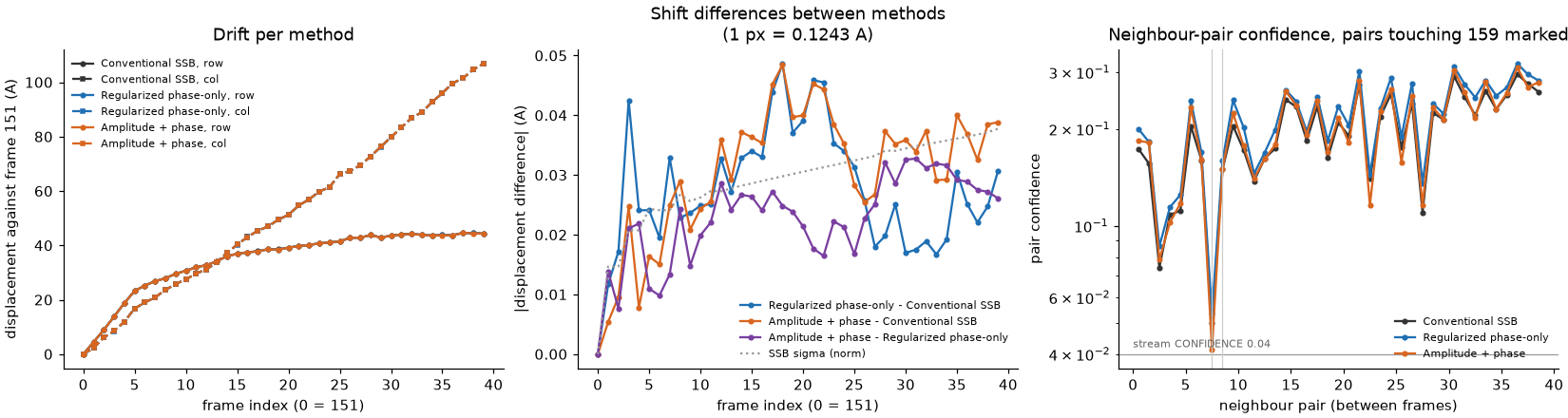
The differences grow along the series as σ does: registration noise, not a lattice image (3.2 Å) or a wrong region.
Every rejected pair is a weak pair outvoted by a confident chain, in all three methods.
The corrected means differ by reconstruction, not by shift: putting the SSB shifts on the regularized stacks changes their means by 5-6 % of the image std, the fringe motion a 0.03 Å shift gives.
Phase-only is the most confident (fewest rejections, highest median). Amplitude + phase brings 158-159 to 0.041, just over the stream’s live cut of 0.04.
Speed of drift() itself#
Same 40 frames, GPU 0 (600 W card), one warm-up: drift() takes 1.03 s for 114 pairs (9 ms a pair), register 20 ms for one pair with its own spot search. Registration is PyTorch on the GPU; running is CuPy. The CPU holds only bookkeeping: spot clustering (a dozen spots) and the least-squares solve (114 x 39).
85 % of GPU time was one complex128 matrix product per pair: the sub-pixel refinement (refine) evaluated the correlation on a 301 x 301 grid (±1.5 px at 1/100 px) as (301 x 1536) @ (1536 x 1536) @ (1536 x 301), 5.3 ms a pair.
Now refine searches in two passes: every 1/10 px over ±1.5 px (31 x 31), then every 1/100 px within ±0.1 px of the best (21 x 21). Without the profiler, best of 3 after a warm-up, GPU 0:
|
|
|---|---|
one 1/100 px grid (frozen baseline) |
0.91 s |
two passes |
0.36 s (2.5x) |
Against the frozen myptycho baseline the displacements are bit-identical on all 40 frames, the synthetic series and register(151, 191). σ and the triple closure move in the last bit (3e-18 Å) because the offsets are now whole multiples of 1/100 px, not steps of a float arange. Of the 114 pair searches, 113 are unchanged; one pair, (151, 154), moves 0.1 px. That pair matched a wrong region 22 Å off (confidence 0.002) and drift rejects it with or without the change: its correlation is flat, so the coarse pass stops on another local maximum.
Does the two-pass search hold beyond this series? Each register was run with the old and the new refinement on 180 synthetic bilayer pairs (sampling 0.1, 0.2, 0.35 and 0.5 Å a pixel, noise 0.3, 3 and 10 times the lattice amplitude, random shifts up to 10 Å) and on 63 the time series pairs one to five frames apart with added noise of 0, 1 and 2 times the phase std. In all 121 synthetic pairs the old search placed within 0.5 px of the truth, and the new one gave the identical shift. All 63 the time series pairs were identical. The 7 that differed (by 0.02 to 0.1 px) were pairs the old search had already got wrong, 0.6 to 95 px off. Why it holds: the correlation peak is as wide as the image’s finest period, at least two pixels at the 0.67 Å band edge, so the 0.1 px pass always lands within one coarse step of the top, and the 0.01 px pass covers that step. Only a flat correlation, where there is no true peak, can make the two disagree.
Files#
Scripts, drift.npz (displacements and σ per method), summary.json and the corrected-mean figures (means_own_shifts.png, means_ssb_shifts.png): a private scratch folder. The float32 stacks were not kept; reconstruct.py remakes them.