quantem.gpu#
GPU-accelerated 4D-STEM analysis for scientists using Python. Load measurements, select diffraction patterns, make detector images, and reconstruct phase with single-sideband ptychography (SSB).
Active development. These examples use the current source checkout, newer than that published as
0.0.1rc8. APIs may change; follow the installation guide and recordgit rev-parse HEADwith results.
Start with Python#
Start here |
What you will do |
|---|---|
Set up Apple Silicon MPS or NVIDIA CUDA |
|
One Gold acquisition: I/O → DPC → SSB |
|
Inspect aberrations and the model probe; compare 1× and 4× |
|
Preserve measurements, calibration, and processing history in QEM |
|
Check parameters, units, return values, and backend limitations |
Your first images#
from quantem.gpu import io, detector
from quantem.core.visualization import show_2d

data = io.load("gold_master.h5")
show_2d(
    [detector.bf(data), detector.adf(data)], title=["BF", "ADF"],
    norm="power_sqrt", cmap="inferno",
)
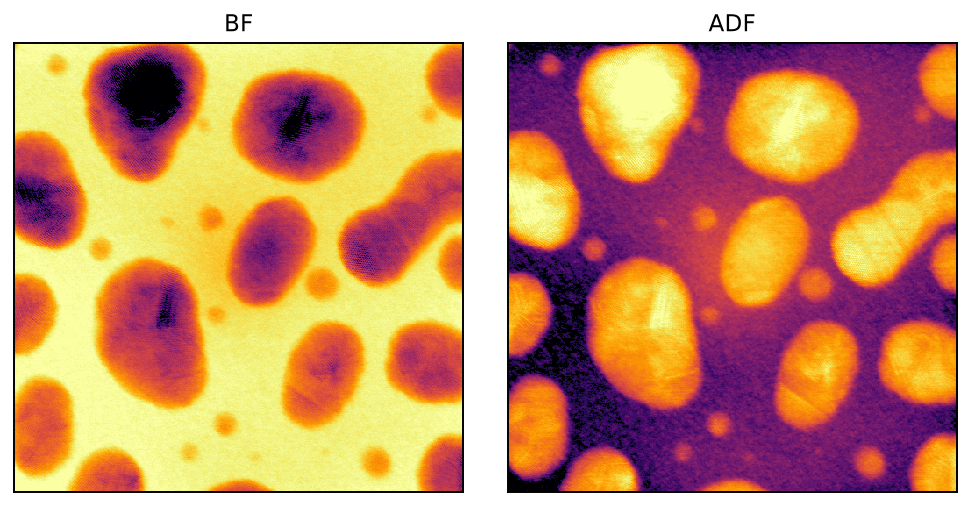
Each image covers a 512 × 512 scan and uses independent square-root contrast. This source has no recorded physical sampling, so no physical scale bar is shown.
The detector fits the bright-field disk automatically. Replace gold_master.h5
with your file; the acquisition is not bundled. Keep data open while working,
then call data.close(). The README
contains the same short workflow and additional static image examples.
What stays consistent#
Python is the interface; MPS and CUDA are execution backends. Supported options differ by operation, so limitations are listed beside their API. Ordinary GPU operations fail explicitly if the requested path is unavailable.
Data use (scan_rows, scan_cols, detector_rows, detector_cols) order,
written \(I[R_r,R_c,k_r,k_c]\) in the scientific guides. data[row, col]
returns a selected GPU Torch tensor. .sampling, .units, and .origin
describe the axes; missing calibration stays unknown. Detector reductions
return small NumPy images while the acquisition remains ANS encoded.
For developers#
The Developer guide groups equations, backend kernels, native integration, file formats, and verification. For the implementation overview, see the implementation dashboard. The verified benchmark results retain revision and hardware provenance. Historical measurements are not promises for every machine.
Citing quantem.gpu#
If quantEM’s interactive widgets, GPU-accelerated I/O, or data processing and reconstruction tools contributed to your research, please consider citing:
Sangjoon Lee et al., “Interactive Framework for Real-Time 4DSTEM Analysis and Reconstruction,” Microscopy and Microanalysis 32 (Supplement 1), ozag053.941 (2026). https://doi.org/10.1093/mam/ozag053.941
Questions and bug reports belong in the issue tracker.