Materials chemistry descriptors
Machine-learning models for solid-state materials are only as good as their descriptors. A compact set of 50 to 1,000 features extracted from chemical composition and crystal structure remains a powerful, data-efficient, and explainable way to learn. These tools generate those features, and the predictions are tested by synthesizing new compounds.
OLED: 98 elemental properties for elements 1 to 92, gap-filled with Gaussian process regression (paper)
CAF: 133 compositional features from a list of formulas (docs, code)
SAF: structural features from
.ciffiles, such as interatomic distances and coordination numbers (docs, code)cifkit: coordination geometry and atomic-site analysis, the engine behind SAF (docs, code)
CIF Bond Analyzer (CBA): minimum bond lengths and bonding trends across binary and ternary systems, with no code to write (code)
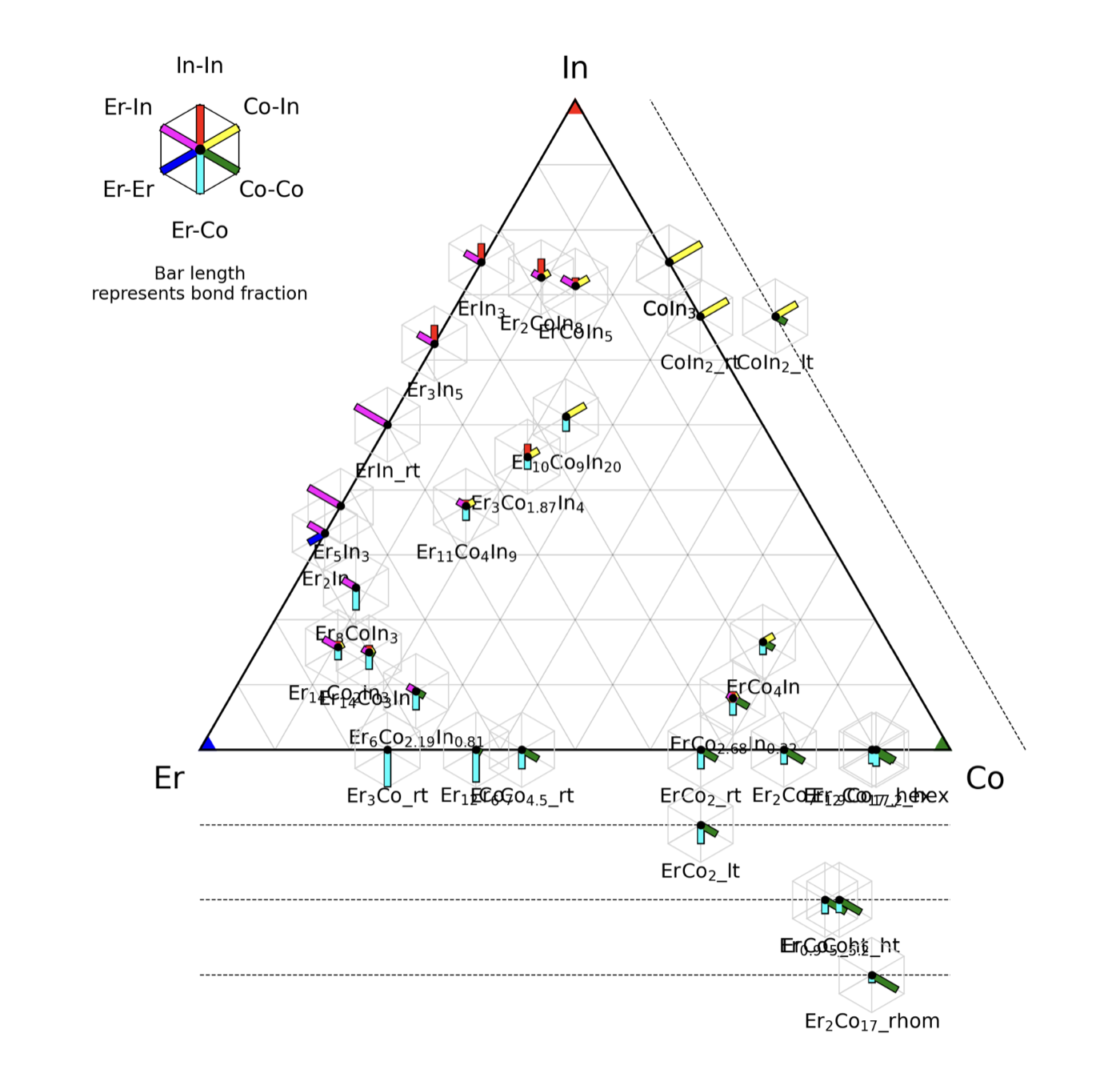
System analysis of the Er–Co–In system. Each known compound is placed by composition, and its hexagonal glyph shows the fraction of each bond type (Er–Er, Er–Co, Er–In, Co–Co, Co–In, In–In), so bonding trends across the whole chemical system can be read at a glance.
Community adoption
The following studies adopted OLED properties and these descriptors in their own research.
TbIr₃ discovery (JACS, 2025). SAF generated 97 compositional and structural features for 2,366 binary 1:3 intermetallics, and PCA with K-means clustering on these features predicted the new compound TbIr₃, which was then synthesized.
Thermoelectric zT (ACS Appl. Mater. Interfaces, 2024). OLED compositional descriptors trained an interpretable model on about 160,000 experimental data points to predict the thermoelectric figure of merit zT.
Thermoelectric web application (ACS Omega, 2026). OLED supplied the elemental vector matrix for compositional features in XGBoost power-factor models, which were compared against Matminer features.
Hydrogen permeability of Pd alloys (Mater. Today Commun., 2026). OLED elemental property tables were combined by the rule of mixtures into composition-based feature vectors for CatBoost models that screened B2-stabilized Pd–Cu–M alloys.
TTT curves of uranium alloys (Sci. Rep., 2026). Ten OLED elemental properties, including atomic radius, valence electrons, electronegativity, and melting point, served as descriptors linking alloy composition to time-temperature-transformation curves.
Gd₁₀RuCd₃ discovery (JACS, 2025). OLED elemental properties supplied the features for PLS-DA site-preference classification in a recommendation engine that led to the synthesis of Gd₁₀RuCd₃.
Thermopower screening (ACS Appl. Energy Mater., 2025). OLED elemental properties were mapped onto each composition and combined into statistically weighted features for a structure-independent Seebeck coefficient model.
Cr³⁺ near-infrared phosphors (Chem. Mater., 2025). 35 OLED elemental variables, expanded into 175 compositional features, trained a model of crystal-field strength that guided the synthesis of new phosphor hosts.
Chemical pressure in intermetallics (JACS, 2024). Atomic properties from OLED, such as electronegativity, entered the descriptors of each atomic contact in a machine-learning chemical-pressure model.
High-temperature alloy design (J. Mater. Res., 2025). Element-wise values for 15 alloy features came from OLED in a CALPHAD-based multi-objective Bayesian optimization.
ErCo₂In and RE–Co–In bonding (Integr. Mater. Manuf. Innov., 2025). CBA, built on cifkit, extracted shortest bond lengths across RE–Co–In systems and showed where RE–Co or Co–In interactions dominate.
CO₂-to-methanol catalysts (ACS Catal., 2025). Atomic properties from OLED, extracted with CBFV, fed an XGBoost model connecting Cu–Ga–Al oxide catalyst compositions to their methanol and dimethyl ether yields.
RE₂₃Co₆.₇In₂₀.₃ structure type (J. Alloys Compd., 2024). The bond and coordination analysis that became CBA determined the coordination environments in this new structure type.